
Words by Ash Kissane
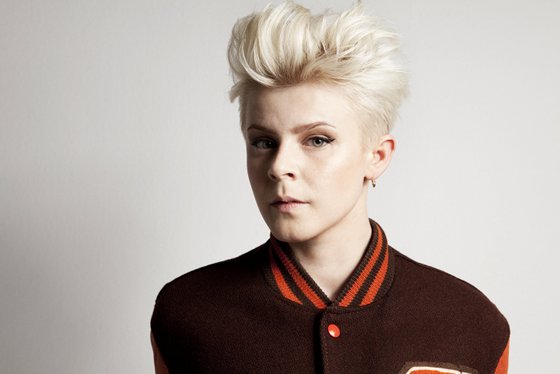
She was thrust into the commercial pop world as a teen, but it was when Robyn decided to go at it alone that she found her real success. After breaking away from her label, Robyn formed her own independent label, Konichiwa Records from which she released numerous number 1 hits, 6 albums (including one triple-length record), and established herself as a force within the pop industry. It had been four years since Robyn last performed in Australia, but she finally returned with an incredible live show for Parklife 2012, much to the delight of loyal fans. I sat down with Robyn to discuss her beginnings, her success, and being a positive role model for young women.
MM: When did you first decide you would pursue music?
R: I don’t know that I ever decided. I think I always wanted to, but I didn’t know how it would happen. I decided to start at a music school; that was the only thought out plan that I had. Somebody saw me perform somewhere before I started at that school, and I was, I guess, discovered and signed before I was going to start high school. That just happened by accident. I wasn’t looking for a record deal or anything. I thought that was way in the future, I didn’t think that would happen so it was pretty random. I started to record an album in the break from ninth grade and, you guys call it “high school”? It turned out to be a huge success and that catapulted me into this very commercial side of the pop industry. I never sought that; it just kind of happened.
MM: How did you then reconcile that? Because you have such a strong creative input in everything that you do, when you were starting out did you feel influence from people who had brought you into that world, that you should sound a certain way? Did you have a clear idea from the start of what you wanted to do?
R: Both, I had a clear idea… I think like most teenage girls, you’re kind of cocky and you think you know what you like. I knew what I wanted to do but at the same time, I don’t think any teenage girl knows how to deal with a situation like that. Of course, it was very difficult to stay in control of everything but I never felt like I was abused by the record industry like a lot of people do. That sometimes becomes the typical way to describe it in articles, but I don’t think that that’s necessarily what happened. I think I was a part of something that was way bigger than I understood. The record company I worked with was a huge commercial record company and wanted to make money and did that, you know, did their job. I was just not really into it. But I think I figured out what I wanted along the way, so in that sense it was very…what do you call it? A learning experience, that definitely had its price. I felt afterwards that it was very hard to trust people, I felt very [much] like I went through everything on my own. Now I have to find out what it is that makes a difference for me. I think that now as I’ve done it a few times, it’s easier to let go of things and not be so controlling (laughs) which I think is good.
MM: Was there anyone along the way that particularly inspired you?
R: Yeah, I think there are lots of people I’m influenced by all the time. I don’t really have one or two role models but everyone from my mother to Neneh Cherry, she’s one of the first alternative pop artists in the world, probably but definitely from Sweden. She released her first album, Raw Like Sushi, when I was ten, and I could not believe that there was a person like that making music in Sweden because there was no one else like that that I could really see myself in. So she was a huge inspiration. But everything, I love Prince, there are so many people that I think have inspired me. I think you’re inspired all the time, like, talking to you or walking through the park. It’s hard to say what affects you at the end of the day.
MM: You have such a strong style and aesthetic in your videos and the way you dress, and in your choreography, where does that inspiration come from when putting together shows? Do you ever take notes from films and things like that?
R: Yeah definitely, one of my favourite clips from any movie is when Rosie Perez dances at the beginning of the movie to Do the Right Thing, to me that was a huge influence to me in everything I do on stage, especially the Call Your Girlfriend video. But I think it’s also about doing something so much that you find your own language, and I’m not saying that I’m not inspired or that I’m not referencing other things because I think that’s impossible to do. I like to take my time with things, I think we live in a world where things are supposed to move really quickly. If you’re asking me how it happens, for me it’s about time and letting things marinate and find its own rhythm.
M: For young girls, you’re quite a strong role model in that you present an image of being very self assured and intelligent and can choose to be sexy when you want to without being overt, which is quite rare for females in the pop industry. Was that ever on your mind that you may be a role model, I guess, for young girls?
F: I think I’ve been trying to find my way. The way you’re describing that makes me think that you’ve thought about those things too and I think it is a difficult path. Because yeah, I want to be a rebel and I want to be out living and I want to be tough, but I don’t want to be ruthless, I don’t want to be egocentric. I want to be aware of what I’m doing, I like things that are soft. Being sexy is one of the most fun things in life, to feel that way. At the same time there are these stereotypes and ways to look at women that are so one-dimensional. I think about it a lot and find my own way to handle it, something that feels interesting and that is true to who I am and then it becomes something. I think it’s about letting things be not so obvious, and sometimes subtle, and sometimes complicated, not so one-sided and allowing that to be.
MM: You’ve performed a lot of shows around the world and have shared the stage with some huge acts like Coldplay, what’s been you’re favourite performance experience so far?
R: I had a great time at one show in Sweden. I’d been touring for a long time and I was getting to the end of this touring period, and I did a show in Gothenburg. I brought some people with me on stage. Dr Alban, who was a huge artist in Sweden and Europe and Africa when I was a kid, he was an African guy who lived in Sweden and he came up on stage with me, and Lykke Li was there as well and Kleerup, who I did “With Every Heartbeat” with. That would probably be one of my favourite shows. It was a one time thing, it was great.
MM: So you’ve been touring straight for nearly three years now, is that right?
R: Yeah, about two and a half.
MM: Have you been writing at all on the road or do you have any plans to put out new material any time soon?
R: Yeah, there will be another album but I have no idea what it’s going to sound like. I’m really bad with writing when I’m touring. I try, always. That is my dream to be able to sit down with a guitar and write after a show but it never happens, I’m always too tired. It’s like a full-time job touring, for me.
MM: How do you go about writing when you do?
R: It’s very different every time, it’s very hard to explain it. I think it’s like anything, if you, for example, get an idea for something you want to write, or I don’t know what else you do, but anyone who is creative knows how it happens. If you get an idea before you go to bed… it’s always unexpected. If I knew what inspired me I’d do it all the time. It’s very hard to describe it. “With Every Heartbeat“, for example, came as one melody totally intact, just in one go. That happens sometimes with me, it’s very rare but it does happen sometimes. Every time you feel like you’ve been possessed by a ghost or a spirit or something because it feels so…it’s a weird experience. Sometimes I will work on a melody for years, sometimes it starts with a lyric.
MM: You’ve worked with some amazing producers and artists, is there anyone you’d love to collaborate with?
R: Those things are so hard to predict, they might happen out of a great meeting or end up being in a studio together by coincidence and sometimes you think you have the perfect collaboration; then you work together and nothing happens. I don’t look at it that way, sometimes it’s good to not work with your favourite artists because it doesn’t mean you’ll work well together.
MM: A lot of people associate you with dance music’s popularity in Europe, is that something that you’ve been influenced by?
R: I think I always thought that I would make pop music, and I that’s what I do. I think dance music… I don’t know what that is, anything above 110BPM, I don’t know. Rave culture was so underground when it started, it was almost the last underground culture coming out in the last twenty or thirty years after Hip Hop. To claim that is almost stupid I think, because it was started by black gay men in Detroit, Chicago and I’m a very different person. I think rave culture has influenced me because when I was a kid there were all these things in the charts in Europe like, Technetronic and even Nina Cherry that were influenced by what dance music actually is. I grew up on the aftermath of that. I’m a product of it but I think I make pop music.
MM: Who did you feel embraced you when you were first coming out, you’ve got quite a wide ranging fan base…
R: It’s usually women and gay men, but in Sweden it’s everyone. Maybe here as well, I think the audience I see is all types. The first shows I did when I released my first album on my own label (Konichiwa Records), what I really loved was seeing how different the crowd was, how many different kinds of people there were in the audience. I was really happy because that’s how I see the world, what I look for, people who are different but that understand that thing. I didn’t think that I would be able to translate that, but looking at the crowd I really felt like I did.
MM: Is there anything else coming up soon that you’re excited about?
R: Yeah, I’m really excited about this. I haven’t been back since 2009 and there have been so many people from Australia on my Twitter and things like that trying to get me to come back and I’ve been feeling so bad. Then I’m doing five shows in November in London, Paris, Berlin, and two other places in Germany that I’m really looking forward to, we’re playing [at] the Brixton Academy in London and a festival in Paris so that should be really fun.
 aislingkissane.com